 Rao Habib
“J.J. Thomson and the Electron: A Milestone in Modern Science”
When we discuss atomic structure, we study the fundamental particles of atoms: electrons, protons, and neutrons. Here, we study the discovery of electrons and the research behind it. A scientist named J. J. Thomson used a high voltage on a gas confined at room temperature in a closed tube, commonly known as a gas discharge tube, which was known to induce electricity to flow through the gas and create light long before the end of the 19th century.
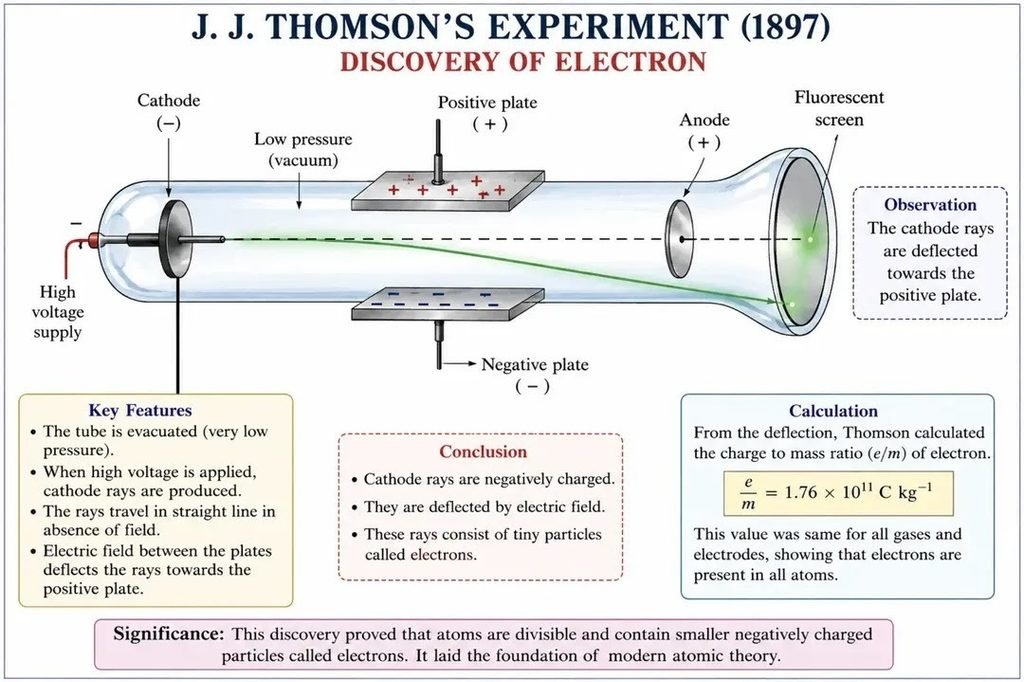
Trying to understand this phenomenon, scientists found that the cathode, or negatively charged electrode, also generated a strange kind of energy called a cathode ray. The British physicist J. J. Thomson (1856–1940) confirmed that atoms were not the most fundamental kind of substance in 1897.
He proved that cathode rays are made of charged particles by showing they could be twisted or deflected by electric or magnetic fields. To do so, Thomson determined the particles’ mass-to-charge ratio by measuring the degree of cathode-ray deflection in magnetic or electric fields of different intensities. The negatively charged cathode released these particles, and the negative terminal of an electric field repelled them. Thomson determined that the particles had a net negative charge because opposite charges attract and like charges repel; these particles are now known as electrons. Thomson discovered that the mass-to-charge ratio of cathode rays is independent of the gas or the metal electrodes, which is most pertinent to the study of chemistry. This finding implied that electrons are essential parts of every atom.
Thomson noted several important characteristics of these rays:
Electric and magnetic field deflection: The cathode rays carried a negative electric charge because they were deflected toward positive charges.
Mass-to-charge ratio measurement
Thomson determined the particles’ charge-to-mass ratio (e/m) by balancing electric and magnetic forces, demonstrating that they were far lighter than any known atom. This demonstrated that particles considerably smaller than atoms exist.
Universality
No matter what kind of gas or metal was employed, the cathode rays’ characteristics remained the same, suggesting that these particles, subsequently dubbed electrons, were essential parts of every atom.
Importance
The electron’s discovery has significant consequences
The discovery helped make modern atomic models possible by challenging the notion that atoms were indivisible.
As a result, Thomson developed the plum pudding model, which depicted the atom as electrons trapped in a positively charged sphere.
It established the groundwork for quantum mechanics and other discoveries, such as Rutherford’s discovery of the nucleus and the subsequent advancement of particle and atomic physics.
Fundamental subatomic particles, electrons, have distinct quantum mechanical characteristics that control their behavior in atoms and materials. They also have a well-defined mass and a negative electric charge.
Fundamental Physical Characteristic
Here, we discuss some fundamental properties of electrons.
Charge
We study that electrons have a negative electric charge of about −1.602 × 10⁻¹¹ coulombs, the opposite sign and equal in magnitude to a proton’s charge. They are therefore necessary for chemical bonding and electric currents.
Mass
They have a mass of around 9.109 × 10⁻³¹ kilograms, and electrons are much lighter than protons and neutrons. Their high mobility in conductors results from their low mass.
Spin
Electrons are particles. They have an intrinsic angular momentum, or spin, with a quantum value of 1/2.
This underpins the Pauli exclusion principle, which regulates how electrons fill atomic orbitals.
Energy Levels
In atomic structure, electrons occupy distinct orbitals, or energy levels, around an atomic nucleus. When they move between levels, they can either emit or absorb energy, producing phenomena like spectral lines.
Wave-Particle Duality
We observe electrons’ dual nature. Electrons can show diffraction and interference in tests because they possess both particle and wave properties, which are characterized by their de Broglie wavelength.
Magnetic Moment
Because of their spin and orbital motion, electrons produce a magnetic moment that influences how they behave in magnetic fields.
Matter and Field Behavior
Conductivity
In metals and semiconductors, electric current is caused by electrons, which are free to move in conductive materials but constrained in insulators.
Electrons engage in chemical bonding and are attracted to protons and repelled by other electrons through electromagnetic forces.
Quantum Effects
In quantum mechanics, electrons are not confined to fixed orbits; instead, they are described by a wavefunction that gives the probability distribution of their location. Tunneling and other quantum phenomena result from this.
Understanding electricity, magnetism, chemistry, and contemporary technologies like electronics, quantum computing, and spectroscopy depends on electrons, which are basic particles. Their interactions with other particles and external fields are determined by their special characteristics, including charge, mass, and spin.
conclusion
- From the study of electrons, we conclude that Electrons are elementary particles, which means we know of nothing that they are made of.
In the Standard Model of particle physics, they are members of the lepton family. Electrons also follow the Pauli exclusion principle, which states that two electrons cannot occupy the same quantum state at the same time within an atom.
Simply put, the electron is a particle with a negative charge and almost no mass, with quantum mechanical properties such as spin and wave behavior. It is fundamental to chemistry, electricity, magnetism, and modern technology, and forms the basis of our understanding of subatomic and atomic phenomena.