 Rao Habib
Every tangible object in the universe from the distance stars burning in the deep space and to the screen you are reading right now is made of the same fundamental units. For centuries everyone has been obsessed with knowing the one question: what is the universe made of?
Atoms are the tiny building blocks of everything around us. For example, the air in which we breathe, the chair we use for sitting, even the photons of light which burn our skin all are built by smallest units which are known as atoms.
Atoms are the smallest units of an element that retain its chemical properties. Understanding atomic structure is central to fields like chemistry, physics, and materials science. The structure of an atom was developed progressively through scientific models, each improving upon the last based on experimental evidence.
The Nucleus, heart of an atom
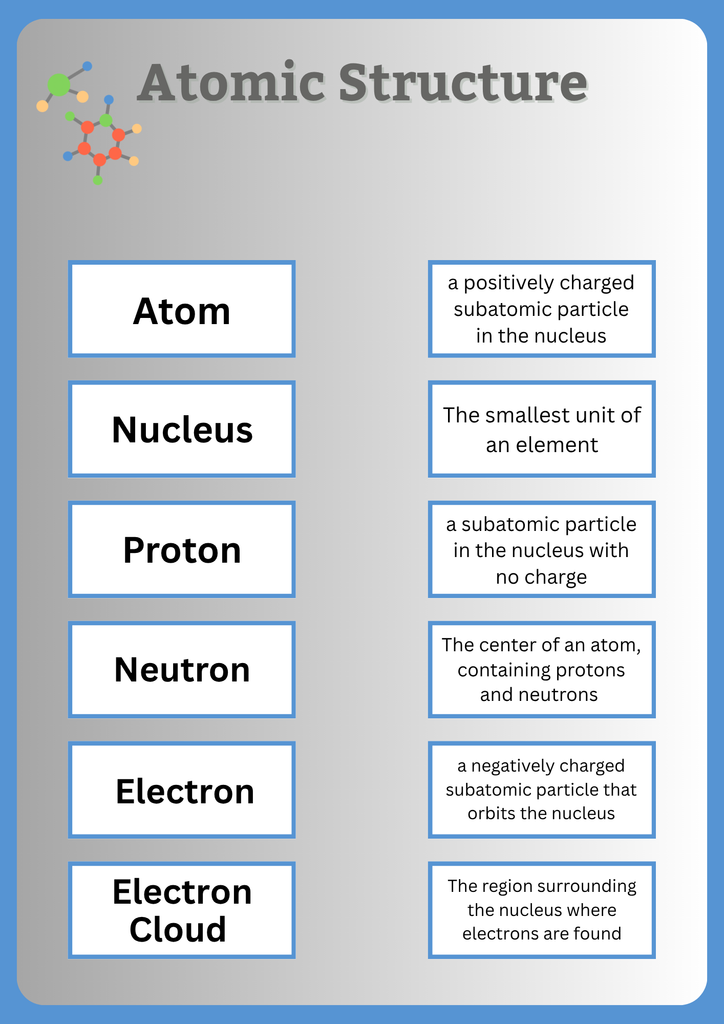
When we study about the structure of an atom we know that at the center of every atom lies the nucleus. That is a compact and hard mass that packs nearly all the mass of an atom. It is like the core of a tiny city that is made up of protons and neutrons. Protons carry a positive electric charge while neutrons are electrically neutral.They are the quiet majority that keeps the nucleus stable. The number of protons in the nucleus is called the atomic number that determines which element an atom represents. For example six protons make carbon and eight protons make oxygen.
The nucleus is incredibly dense. If the size of an atom is like a football stadium the nucleus would be like a cherry at the center of this stadium. Despite its smaller size it governs the atom’s identity and contributes nearly all of its mass.https://alziwaq.com/j-j-thomson-and-the-electron-key-concepts-in-atomic-structure/
Moving Electrons the Cloud Around the Nucleus
Surrounding this dense nucleus is a vast almost empty space populated by electrons and tiny negatively charged particles that move. Unlike planets and a sun that is moving in predictable orbits we see that electrons always exist in clouds or probability zones regions where they are most likely to be found. These clouds are not fixed paths but these are dance floors of an atom where electrons dance and move according to the rules of quantum mechanics.
Electrons determine the chemical properties of an atom. How they are arranged in shells and subshells and how atoms form bonds and create the molecules that form water, proteins, air and the essential substances that make life possible.
Forces Holding the Atom Together
We have a question in our mind, if the electrons are negatively charged and the protons positively charged so why doesn’t the atom collapse? The answer to this question lies in the electromagnetic force which draws the electrons toward the positively charged nucleus and balanced by the electrons and quantum motion keeping them from spiraling inward. Inside the nucleus the strong nuclear force overcomes the repulsion between protons. And tightly binding them with neutrons with force that is stronger than normal chemical forces.
We define that
Atoms are the fundamental building blocks of matter and consist of a dense nucleus made of protons and neutrons and surrounded by a cloud of electrons arranged in specific energy levels.
The smallest piece of an element that maintains the identity of that element is called an atom. Individual atoms are extremely small. It would take about fifty million atoms in a row to make a line that is 1 cm long. The period at the end of a printed sentence has several million atoms in it. Atoms are so small that it is difficult to believe that all matter is made from atoms but it is made of.
Components of the Atom
- Nucleus
The structure of an atom contains protons that positively charge particles and neutrons that are the neutral particles, which together form nearly all the mass of an atom. The number of protons is also called the atomic number and defines the chemical element.
2. Electrons
Electrons are negatively charged particles orbiting the nucleus in regions called electron shells or energy levels. In a neutral atom the number of electrons generally equals the number of protons and ensures electrical neutrality. These electrons determine the atom’s chemical reactivity and bonding behavior.
Electron Arrangement
Electron Configuration and Energy Levels
Electrons occupy energy levels or shells around the nucleus. And each shell is capable of holding a specific maximum number of electrons.
- First shell (closest to nucleus) and have 2 electrons
- Second shell have 8 electrons
- Third shell occupy 18 electrons, and so on
Electrons occupy specific energy levels according to the Pauli exclusion principle and Hund’s rule. Firstly they are filling lower energy orbitals before higher ones. The configuration is often represented using electron configuration notation or orbital diagrams which show how electrons are distributed among shells (K, L, M…) and orbitals (s, p, d, f).
Atomic Models
1. Dalton’s Model (1803).
We study according to the Dalton model Atoms are indivisible spheres.
2. Thomson’s Model (1897)
J J Thomson Proposed electrons embedded in a positively charged “pudding.”which is known as plum pudding theory.
3. Rutherford’s Model (1911)
We study the Rutherford model, which finds a dense nucleus in the centre of an atom with electrons orbiting around it which is based on alpha-particle scattering experiments.
.4 Bohr Model (1913)
Niel Bohr did an experiment and found that electrons travel in discrete orbits or energy levels and explained hydrogen spectra.
5. Quantum Mechanical Model (1926 onwards)
We study that this model describes electrons as probability clouds rather than fixed orbits. Quantum numbers (n, l, m, s) define the allowed energy and position of electrons.
Significance of Atomic Structure
- Chemical Properties
From the atomic structure we determine the valence and bonding capabilities by electron arrangements.
- Isotopes
Atoms with the same number of protons but different neutrons have distinct physical properties, used in medicine and dating techniques.
- Periodic Table Organization
In the periodic table elements are arranged by atomic number and properties that arise from electron configurations.
Advanced Concepts
- Electron Clouds
We know by studying the atomic structure modern experiments support that electrons occupy a cloud-like region rather than fixed paths.
- Subatomic Forces
With the help of the structure of an atom we know that some forces like nuclear forces bind protons and neutrons and while electromagnetic forces maintain the attraction between electrons and nucleus.
- Quantum Mechanics
It explains phenomena like energy quantization, chemical bonding, and magnetic properties.
Quantum Mechanical Model of the Atom
The quantum mechanical model revolutionized our understanding of atomic structure by introducing a probabilistic framework that superseded classical deterministic models. This paradigm shift was primarily facilitated by the development of the Schrödinger equation, which describes how the quantum state of a physical system changes over time.
Schrödinger Equation and Orbitals
Erwin Schrödinger’s formulation of wave mechanics in 1926 introduced the concept of the wavefunction
(ψ), a mathematical function that encapsulates the probability amplitude of an electron’s position and momentum
Solving the equation for electrons in an atom yields atomic orbitals region in space where the probability
Finding an electron is significant. These orbitals are characterized by a set of quantum numbers:
Principal Quantum Number (n): Determines the energy level and size of the orbital.
Azimuthal Quantum Number (l)
Which Defines the shape of orbitals.
Magnetic Quantum Number (m_l)
This quantum number specifies the orientation of the orbital in space.
Spin Quantum Number (m_s)
This indicates the intrinsic spin of the electron.
These quantum numbers are integral in determining the unique state of an electron within an atom and influencing chemical bonding and spectral properties.
Key concept
- Atomic number (Z)
We know that the number of protons in the nucleus is the atomic number which defines the element.
- Mass number (A)
We study that the total number of protons and neutrons is the mass number which identifies specific isotopes.
- Isotopes
Atoms with the same number of protons but different numbers of neutrons are isotopes.
- Valence electrons
It helps us to understand the electrons in the outermost shell that influence chemical reactions.
conclusion
We conclude by studying the atomic structure it is the organized arrangement of protons and neutrons in the nucleus and electrons in surrounding shells. Which together help us to determine the chemical properties, stability, and behavior of each atom in elements and compounds.