 Rao habib
We Know that Stoichiometry in chemistry textbooks is often represented as a set of equations, numbers and ratios. We study that stoichiometry is about balance, relationships and understanding the world at the molecular level. Stoichiometry is the story about how the atoms engage, transform and cooperate..
For example, when we cook a dish in a kitchen, we use each ingredient in the right proportions. If we add too much salt and too little flour, we ruin our dish. Similarly, in chemistry atoms and molecules are the ingredients and reactions is our recipe so we say that,
Stoichiometry is the art and science of measuring exactly how much of each substance is needed so the “recipe” works perfectly.
For example, reactants are our start ingredients, and products are our final dish. Ratios from balanced chemical equations tell us how much of each ingredient is needed to avoid excess waste or shortages.
For example,
2H2 + O2 – 2H2O: Two molecules of hydrogen combine with one molecule of oxygen to produce two molecules of water. If you use the right “amounts” of hydrogen and oxygen nothing is wasted just like following a recipe. We define stoichiometry.
Stoichiometry is the science of measuring the quantitative relationships between the reactants and products in chemical reactions. And it plays an important role in our daily life, from cooking and medicine to industrial manufacturing and environmental protections.
Concept of stoichiometry
- Mole Concept.
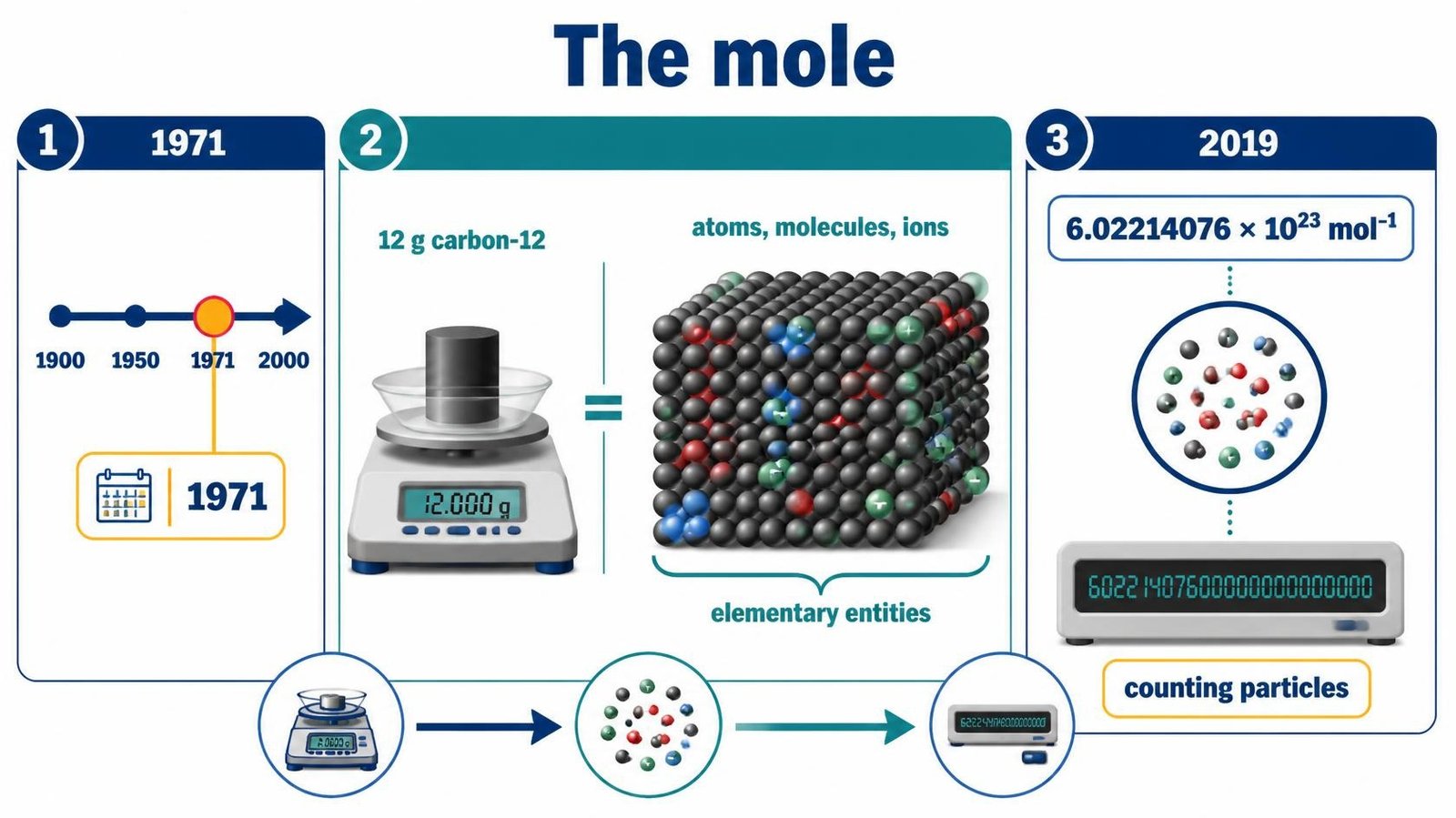
Stoichiometry depends on the idea of moles, which is a unit representing 6.022×10²³ particles like atoms, molecules, or ions of a substance. A chemist relates quantities of different substances in a reaction by using moles.
- Balanced Chemical Equations
To perform stoichiometric calculations, we must have a balanced chemical equation. And each element must have the same number of atoms on both sides of the equation.
We can determine the ratio of moles of one substance to another by using coefficients in a balance equation.. For example in the reaction like,
2H2+O2→2H2O
The mole ratio of hydrogen to oxygen is 2:1 which means 2 moles of hydrogen react with 1 mole of oxygen to produce 2 moles of water.
- Conversions
We know that stoichiometry involves converting between grams, moles and molecules using molar mass and Avogadro’s number.
- Limiting and excessive reactants
In real chemical reactions, one of the starting materials might be used up before the others. Stoichiometry helps us to figure out which material is the limiting reactant and that decides how much of the final product can actually be made.
- Applications
Stoichiometry is not only important in laboratory chemistry but also in industries like pharmaceuticals, food production and environmental science where precise chemical quantities are crucial.
Example.
If you want to react 4 moles of hydrogen with oxygen to form water using the balanced equation.
2H2 + O2 – 2H2O
From the ratio 2:1, you need 4÷2=2 moles of oxygen.
You will produce 4 moles of water.
This example shows how stoichiometry helps calculate the amounts of reactants and products in a chemical reaction.
Limiting reactants problems
To solve the limiting reactants problems, we follow the following steps.
- We ensure that the chemical equation has balanced stoichiometry coefficients for all reactants and products.
- We use the molar mass of each reactant to convert the grams into moles.
n =m/ M
- We compare the actual mole ratio of reactants with the stoichiometric mole ratio from the balanced equation.
- By dividing the actual moles of each reactant by its stoichiometric coefficient.
Ratio = n reactants/ coefficients.
- We study that the limiting reactants determine the maximum product.
- We conclude that the excess reactant may remain and is calculable.
- And it is always based on calculations on moles and stoichiometric ratios.
Why Stoichiometry Matters to Humans:
Stoichiometry is not just about laboratory reactions. It is the bridge between microscopic atoms and macroscopic everyday experiences.
Medicine. Accurate dosing of drugs requires precise molecular calculations.
Environmental Science.
It helps in predicting emissions and chemical impacts and needs balanced equations..
Cooking and Baking.
Stoichiometry helps in cooking and baking to ensure the proper chemical balance. And help to maintain the consistent texture, correct flavor and predictable results.
Industrial Chemistry.
In industry, producing plastics, fuels and materials efficiently depends on perfect chemical ratios and stoichiometry.
Humanizing the Numbers
Humanizing the Numbers in stoichiometry can feel cold. We transform them into stories.
1 mole of oxygen molecules wants to find its two hydrogen friends to make water. We say that molecules are cooperative actors.
Percent yield is similar to a baker checking how much cake they actually get compared to what the recipe says they should make.
Connecting Emotion and Discovery
Stoichiometry also teaches patience, foresight and precision skills that show human experiences beyond the lab. Making a reaction successful as teamwork: Everyone has a role, and timing counts.
Industrial importance.
Stoichiometry involves applying the principles of stoichiometry and quantitative relationships between reactants and products to large-scale chemical manufacturing processes. It is essential for optimizing yields and reducing waste. And it helps to ensure safety in chemical industry operations.
Here we discuss some examples of stoichiometry in industries..
Haber-Bosch Process (Ammonia Production)
Reaction
N2(g)+3H2(g)⟶2NH3(g)
According to Stoichiometric Principles we use accurate ratios of nitrogen to hydrogen (1:3) which are crucial to maximize ammonia yield.
Industrial Relevance
We determine feedstock requirements of N₂ and H₂.
It allows calculation of expected ammonia output per batch.
It guides reactor design parameters such as pressure and temperature.
2. Contact Process (Sulfuric Acid Production)
Reactions
Oxidation of sulfur. Firstly, oxidize the sulfur.
S+O2⟶SO2
Then Catalytic conversion occurs
2SO2+O2 V2O5 2SO3
And finally formation of sulfuric acid occurs.
SO3+H2O⟶H2SO4
Stoichiometric Application.
We can calculate the mass of SO₃ produced from a given mass of sulfur.
We can optimize O₂ supply to avoid excess reactants and maximize efficiency.
3. Color-Alkali Process
Reaction (Electrolysis of Brine)
2NaCl+2H2O⟶2NaOH+H2+Cl2
Stoichiometric Calculations.
We must quantify the required NaCl to produce a targeted mass of NaOH.
We can determine hydrogen and chlorine co-product quantities.
It ensures electrical efficiency per mole of product formed.
4. Petrochemical Industry (Ethane to Polyethylene)
Reaction
nC2H4⟶−(C2H4)n−
Stoichiometry in Practice
We can determine monomer consumption for a desired polymer output.
We account for conversion efficiency and unreacted monomer recovery.
5. Cement Manufacturing
Simplified Calcination Reaction
It helps in cement manufacturing.
CaCO3⟶Can+CO2↑
Stoichiometric Importance
It enables prediction of Can yield from limestone.
It is critical for CO₂ emission estimates and raw material utilization.
6. Pharmaceutical Production
For example Aspirin (Acetylsalicylic Acid) Synthesis
C7H6O3+(CH3CO)2O⟶C9H8O4+CH3COOH
Industrial Stoichiometry
It helps to determine limiting reagents and required excess.
It ensures batch consistency and cost-effective use of acetic anhydride.
7. Fertilizer Industry (Triple Super phosphate Production)
Reaction
Ca3(PO4)2+3H2SO4⟶Ca(H2PO4)2+2CaSO4
Application.
It helps in optimizing phosphoric acid usage. And Controlling Case₄ by-product accumulation.
Conclusion.
Industrial stoichiometry ensures efficient resource allocation, maximizes yield, and minimizes waste.
It is often combined with optimization processes, economic analysis and environmental considerations for large-scale production.
Modern industries use computer-aided stoichiometric calculations to simulate reactions under varying process conditions. It helps us in scaling-up from lab to plant scale.
stoichiometry is essential for understanding the quantitative relationships in chemistry and ensures reactions are carried out efficiently and accurately.