 Rao habib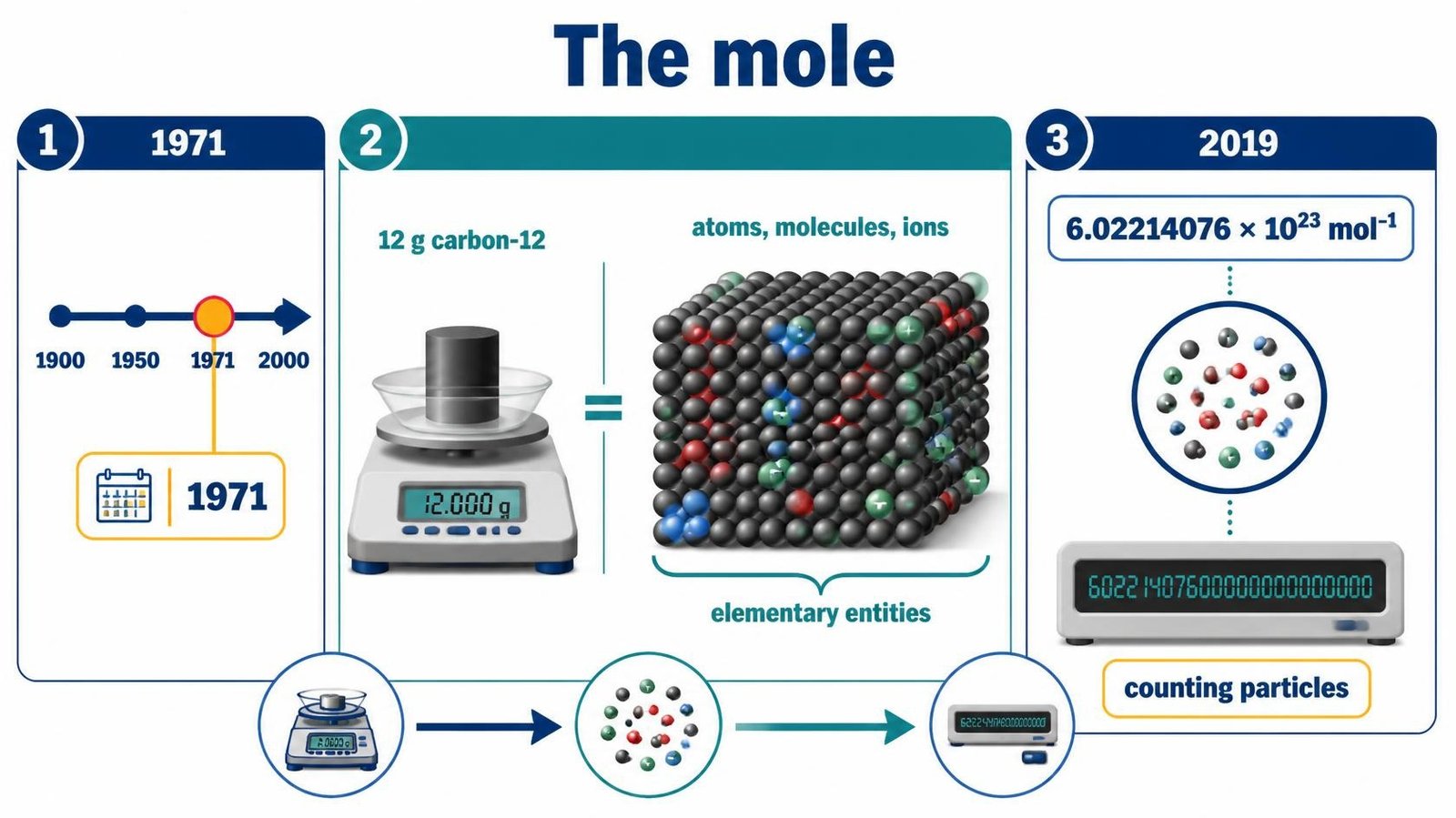
1History of the mole concept.
We study that the mole concept is a key idea in chemistry that helps count substances. It has developed over the past 200 years and started with early scientists studying atoms and molecules.
Early Developments
The idea of the mole started with Amedeo Avogadro in 1811. He said that equal volumes of gas at the same temperature and pressure have the same number of molecules. This helped to distinguish between atoms and molecules and made it easier to understand how chemical reactions work with particle numbers. But Avogadro’s work was not recognized right away. It became more important later in the 1860s, especially after Dmitri Mendeleev helped develop the periodic table.
Introduction of the Mole Concept.
We study that the word mole comes from the German word MOL, which is related to “Molecule” molecule.
It was used in the late 1800s and early 1900s to count particles in chemical reactions. The mole helped to link the mass of a substance to the number of its tiny particles. And making it easier to use in chemical equations. At first the mole was used to describe a gram molecular weight or gram formula weight which is based on a substance’s molecular or atomic mass in grams.
Avogadro’s Number and Standardization
In 1909 Jean Perrin did experiments to find out how many particles are in a given amount of a substance.
This number is now called Avogadro’s number about 6.022 × 10 2 3 particles per mole. Perrin’s work gave us experimental proof of this number and connected the mole to real physical measurements. And making it easier to do precise calculations in chemistry and physics.
Modern Definition
The mole became an official SI unit in 1971. It is defined as the amount of a substance that contains as many elementary entities like atoms, molecules or ions as there are atoms in 12 grams of carbon-12.This linking of the mole to a specific mass allowed chemists to measure substances reliably. In 2019 the SI system redefined Avogadro’s number as an exact value of 6.02214076 × 10²³.This means the mole is now based on counting particles not on a fixed mass of carbon.
The mole concept has gone through several important steps.

In 1811,In Avogadro proposed that equal volumes of gas have equal numbers of molecules.
In the late 1800s, the term “mole” was introduced to connect mass with particle count.
In 1909 Jean Perrin determined Avogadro’s number through experiments.
In 1971, the mole was made an official SI unit based on carbon-12.
In 2019, the mole was redefined to use an exact number of particles.
Some basic concepts of mole.
The mole is a basic idea in chemistry that connects the mass of a substance to the number of particles it contains.
It allows chemists to count particles by weighing them.
Definition of a Mole
We define that a mole is the amount of a substance that contains exactly 6.022 × 10 2 3 particles. These can be atoms, molecules, ions, or electrons. We know that this number is very big because atoms and molecules are very small. We know that,
1 mole of atoms has 6.022 × 10²³ atoms.
1 mole of molecules has 6.022 × 10²³ molecules.
Example of mole calculation:
Mole concept in chemical reactions.
We know that the mole is fundamental in chemistry that connects the number of particles to the amount of a substance.
Here we discussed some examples of how the mole is used in chemical reactions.
- Counting Atoms
For example Carbon-12 is defined so that 1 mole of carbon atoms contains 6.022 × 10 2 3 atoms Avogadro’s number.
If you have 12 grams of carbon-12, you have exactly 1 mole of carbon atoms.
- Chemical reactions
For example, the formation of water.
2H₂ + O₂ → 2H₂O
According to the mole concept 2 moles of hydrogen gas react with 1 mole of oxygen gas to make 2 moles of water molecules.
- Calculating Mass of Compounds
For example Sodium chloride (NaCl)
Molar mass= 23 + 35.5 = 58.5 g/MOL
If 1 mole of NaCl weighs 58.5 g and contains 6.022 × 10²³ formula units of NaCl.
- Gases and the Ideal Gas Law
For example, 1 mole of an ideal gas at standard temperature and pressure (STP) takes up 22.4 liters.
If you have 44.8 liters of oxygen gas at STP, then you have 2 moles of oxygen molecules.
- Counting Molecules in Solutions
For example, in 1 liter of a 1 M (molar) solution of HCl.
If 1 mole of HCl (about 36.46 grams) is mixed with 1 liter of water.
This solution has 6.022×10²³ molecules of HCl.
Verification.
The examples cover atoms, molecules, mass, gas volume, and concentration.
Each shows the regular use of Avogadro’s number and the mole idea. It makes sure the examples are right and useful. The mole idea is important for linking the tiny scale (atoms and molecules) with the bigger scale (grams and liters). It helps in doing calculations in chemistry.

All Mole Concept Formulas
Here we discuss all mole concept formulas that help us to calculate the mass, molar mass, volume and concentration.
Here we discuss the main formulas and explanations.
Number of Moles (n)
The basic idea of a mole connects the number of particles like atoms, molecules, or ions to moles.
n = N / NA
Where:
n = number of moles;
N = number of particles like atoms, molecules and ions.
NA = 6.022×10²³ MOL⁻¹ (Avogadro’s number)
2. Moles from Mass
n = m / M
Where:
m = mass of the substance in grams
M = molar mass of the substance (g/MOL)
3. Molar mass
M = m / n
Where.
M = molar mass
m = mass of substance
n = number of moles
4. From Gas Volume (at STP)
At standard temperature and pressure STP, 0°C and 1 atm)
1 mole of gas takes up 22.4 liters
n = V / 22.4 L
Where.
V = volume of gas (liters)
n = moles.
For conditions not at STP, we use the ideal gas law.
PV = NRT
5. Concentration for solutions.
n = C × V
Where.
C = concentration in MOL/L (molarity, M)
V = volume of solution in liters (L)
6. Percentage composition and empirical formula.
Mass Percent of an element.
Element = Mass of element in compound / Molar mass of compound × 100
Empirical formula calculation.
Moles of each element = Mass of element / Atomic mass.
Then divide by the smallest number of moles to get the ratio.
7. Stoichiometry Relating Reactants and Products
We use balanced chemical equations.
Na : NB : NC
Where the ratio of moles of reactants and products matches the coefficients in the balanced equation.
8. Avogadro’s Law. Volume and Moles of Gas at the Same Time and P.
V1/n1 = V2/n2
Where.
V = gas volume
n = moles of gas.
By using these formulas, we can connect mass, moles, volume, number of particles and concentration in chemical calculations.
We should always check the units in your calculations.
- Mass in grams (g)
- Volume in liters (L)
- Molarity in moles per liter MOL/L
- Avogadro’s number for counting particles
These formulas are the main tools for solving problems related to the mole idea in chemistry.
Mole and Molar Mass Relations
We study that the mole and molar mass are key for understanding the relationships between substances.
1.The Mole Concept:
A mole is a unit used to measure the amount of a substance.
It is the amount of a substance that contains Avogadro’s number of particles like atoms, molecules, ions, or electrons.
1 mole = 6.022×10²³ particles
This helps chemists count very large numbers of tiny particles using bigger amounts of material.
Molar Mass
The molar mass of a substance is the mass of one mole of that substance.
It is expressed in grams per mole (g/MOL) and numerically equal to the atomic mass for elements or molecular mass for compounds in atomic mass units (amu).
For example Hydrogen (H) has an atomic mass of 1 u → molar mass = 1 g/MOL.
Water (H₂O) has a molecular mass of
2(1) + 16 = 18
u → molar mass = 18 g/MOL.
Relationship Between Mole and Molar Mass.
We study the relationship between mole and molar mass by the formula.
Number of moles = Mass of substance (g)) / Molar mass (g/MOL))
If we know the mass of a substance, we can find how many moles it has.
If we know how many moles we can figure out the mass of the substance by using this formula
Mass = Number of moles × Molar mass
Suppose you have 36 grams of water (H₂O). To find moles in water, we need to know the molar mass of water. The molar mass of H₂O is 18 grams per mole.
Number of moles = 36 grams ÷ 18 grams/mole = 2 moles
This means that 36 grams of water is made up of 2 moles of water molecules.
We say that each mole has 6.022 × 10²³ molecules, so 2 moles have 2× 6.022 × 10²³ = 1.204 × 10²⁴ molecules.
We say that a mole is a way to count the number of particles like atoms or molecules.
Molar mass is the mass of one mole of a substance.
The formula to find mass is:
Mass = moles × molar mass
or to find moles it is
moles = mass ÷ molar mass.
It helps us to link the weight of a substance to the number of particles it contains.
Formula.
Number of moles = Mass of substance ÷ Molar mass
Applications of the Mole Concept.
The mole concept is a basic idea in chemistry that lets scientists count tiny particles like atoms, molecules, and ions by using the amount of a substance in grams.
Here are the main uses of the mole concept in chemistry. We discuss here some applications of the mole concept.
- Stoichiometry of Chemical Reactions.
The mole concept helps us to understand how much of each substance is needed or produced in a chemical reaction.
For example, in the reaction 2H₂ + O₂ → 2H₂O two moles of hydrogen react with one mole of oxygen to make two moles of water.
2. Finding Molecular and Empirical Formulas.
We can find the empirical formula and molecular formula by using the mole concept. By measuring the mass of each element in a compound and turning those masses into moles, we can find the simplest ratio of atoms like an empirical formula and the exact number of atoms in a molecular formula.
3. Calculating Masses of Reactants and Products
By using the mole concept, we can calculate the mass of substances that take part in chemical reactions.
4.Gas Volume Calculations.
At standard temperature and pressure (STP), we take one mole of any gas up to 22.4 liters.
This helps us in working out the volume of gases involved in reactions.
5. Solution Concentration or Molarity.
We define that the Molarity is a way to measure how much of a substance is in a solution.
It is calculated as moles of solute per liter of solution.
For example, to make a 1 M NaCl solution, you need 1 mole of NaCl dissolved in 1 liter of water.
6. Using Avogadro’s Number.
We study that Avogadro’s number (6.022 × 10²³) connects the number of particles in a substance to the number of moles. It helps us to turn particles into moles and vice versa.
7. Calculating Yield and Efficiency
Chemists use moles to calculate how much of a product should be made (theoretical yield) and how much actually is made, which is known as actual yield, which helps them understand the efficiency of reaction.
8.Quantitative Analysis
It also helps in quantitative analysis. The mole concept is used in titrations and other chemistry methods to find the exact concentration of a substance.
9.Pharmaceuticals and Biochemistry
When we make medications or study biochemical reactions, the mole concept is used to calculate the correct amounts of ingredients or how reactions will behave.
Conclusion.
The mole concept connects the tiny world of atoms and molecules with the larger world of grams and liters. It is used in all areas of chemistry, from lab work to big industries and scientific research.